
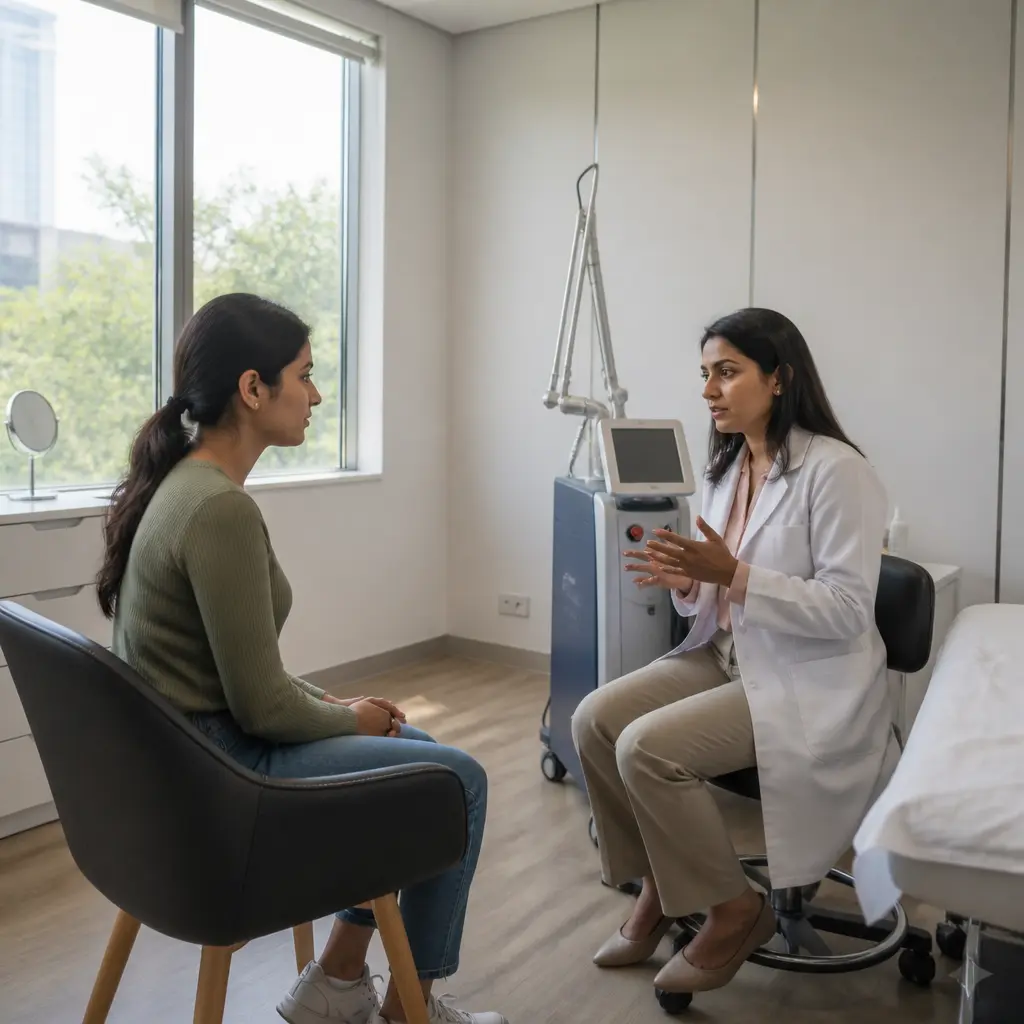
Modern laser resurfacing’s precision is transforming acne-scar treatment by delivering controlled energy to selected layers of skin rather than removing or heating an entire surface. Acne scars are permanent textural or color changes left after inflammatory acne, and the American Academy of Dermatology reports that acne affects up to 85% of people between ages 12 and 24. Today, fractional ablative lasers, nonablative lasers, picosecond devices, vascular lasers, and combination treatment plans can be matched to scar type, skin tone, downtime tolerance, and risk of post-inflammatory hyperpigmentation. Clinical studies commonly report meaningful texture improvement after several sessions, although results vary and no laser completely erases every scar.
Improves: Modern Laser Resurfacing Precision
Modern laser resurfacing precision is the ability to create microscopic, carefully measured zones of heating or tissue removal while leaving surrounding skin relatively intact. Dermatologists use this controlled injury to stimulate collagen remodeling, soften depressed scar edges, reduce uneven pigmentation, or diminish persistent redness. The American Society for Dermatologic Surgery describes laser resurfacing as a treatment that removes damaged skin or heats deeper tissue to encourage new collagen formation.
The central improvement over older, fully ablative resurfacing is selectivity. Instead of treating 100% of the surface, fractional devices treat a pattern of microscopic columns. Untreated skin between those columns supports faster healing, often reducing recovery time and some complications. A 2022 review in Dermatologic Surgery noted that fractional lasers have become important tools for acne-scar management because they balance clinical improvement with a more manageable safety profile than traditional full-field resurfacing.
Fractional Ablative Lasers
Fractional ablative lasers remove narrow columns of skin and heat adjacent tissue. Carbon-dioxide lasers commonly operate at 10,600 nanometers, while erbium:YAG lasers operate near 2,940 nanometers. Both can remodel rolling and shallow boxcar scars, but carbon-dioxide treatment generally produces stronger thermal coagulation and potentially more collagen contraction, whereas erbium:YAG treatment may involve less heat and a shorter recovery period.
Ablative fractional treatment is often selected when texture is the primary concern and the patient accepts several days of redness, swelling, peeling, or crusting. Published studies frequently report moderate improvement after one to three sessions, with outcomes assessed through physician scar scales, standardized photographs, and patient questionnaires. Actual improvement depends on scar depth, treatment settings, skin type, aftercare, and whether other procedures are added.
Nonablative Fractional Lasers
Nonablative fractional lasers heat the dermis without intentionally removing the surface layer. Common systems use wavelengths such as 1,540, 1,550, or 1,927 nanometers. Because the epidermis remains more intact, recovery is usually easier than with ablative resurfacing, although more sessions are commonly needed.
These lasers are useful for patients who want gradual improvement with less interruption to work or school. They can soften mild-to-moderate atrophic scars and may also improve uneven tone. Their lower downtime does not mean zero risk: temporary redness, swelling, acne flares, and pigment changes remain possible, especially in darker skin tones or after excessive sun exposure.
Picosecond and Fractionated Energy Devices
Picosecond lasers deliver energy in pulses lasting less than one nanosecond. In acne-scar treatment, fractionated picosecond devices use diffractive or holographic optics to create microscopic injury zones and stimulate remodeling without the same degree of surface vaporization produced by carbon-dioxide resurfacing. They may be considered when limited downtime is important or when pigment risk makes aggressive ablation less desirable.
The evidence base for picosecond devices is promising but smaller than the evidence for established fractional carbon-dioxide and nonablative systems. A 2023 systematic review in Lasers in Medical Science found improvement in atrophic acne scars across multiple picosecond studies, but also emphasized differences in devices, settings, follow-up periods, and outcome measurements. This means attractive marketing claims should not substitute for a dermatologist’s assessment.
Targets: Modern Laser Resurfacing Scar Types
Laser selection works best when the scar is classified before treatment. Acne scarring is not one condition: depressed scars, raised scars, redness, and brown or gray discoloration require different strategies. The scar’s depth and attachment to underlying tissue may matter more than the device name.
Rolling and Boxcar Scars
Rolling scars are broad depressions with soft, sloping edges, often caused by fibrous bands pulling the skin downward. Boxcar scars are round or oval depressions with more sharply defined vertical edges. Fractional ablative and nonablative lasers can stimulate collagen and soften their borders, particularly when the scars are shallow.
Deep rolling scars may require subcision before or alongside laser treatment. Subcision releases the fibrous attachments beneath the scar; the laser then addresses surface irregularity and collagen remodeling. Combining procedures can be more logical than repeatedly increasing laser intensity, because a surface laser cannot reliably release a deep tether.
Ice-Pick Scars
Ice-pick scars are narrow, deep openings that extend farther into the skin than their small surface diameter suggests. Conventional laser resurfacing may improve their edges but often cannot fill the deepest portion efficiently. Dermatologists may instead recommend punch excision, punch elevation, or chemical reconstruction of skin scars, followed by fractional laser treatment for blending.
This distinction explains why a patient can receive a technically successful laser treatment and still see persistent deep pits. Treating the correct scar subtype is a major part of modern precision care.
Red and Brown Post-Acne Marks
Post-inflammatory erythema is lingering red or purple color after acne, while post-inflammatory hyperpigmentation is excess brown or gray pigment. These marks are not the same as depressed scars and may respond better to vascular or pigment-targeting approaches, strict photoprotection, and topical medication than to aggressive resurfacing.
Pulsed-dye lasers may target persistent redness by treating superficial blood vessels. Q-switched or picosecond pigment-focused devices may be considered for selected pigmentation, but pigment lasers can also worsen dark marks if used too aggressively. The American Academy of Dermatology emphasizes daily broad-spectrum sunscreen because ultraviolet exposure can darken post-acne discoloration and undermine treatment results.
Reduces: Modern Laser Resurfacing Recovery and Risk
Modern laser treatment reduces risk mainly through fractional delivery, adjustable energy, cooling systems, test spots, and patient-specific planning. It does not eliminate complications. Temporary redness and swelling are common; prolonged redness, infection, acne or milia flares, delayed healing, scarring, and temporary or permanent pigment changes are less common but clinically important.
Skin Tone and Hyperpigmentation Planning
Darker skin contains more active melanin and has a higher risk of post-inflammatory hyperpigmentation after thermal injury. This does not automatically rule out laser treatment, but it often favors conservative settings, nonablative or longer-wavelength options, pretreatment of active inflammation, and meticulous sun protection. The American Society for Laser Medicine and Surgery recommends that treatment decisions account for skin type, wavelength, fluence, pulse duration, and cooling.
A qualified clinician may use the Fitzpatrick skin phototype system as one planning tool, but it is not a complete risk assessment. Recent tanning, a history of keloids, active infection, use of photosensitizing medicines, and poor wound healing can also affect candidacy. A test spot may be useful when pigment risk is substantial.
Aftercare and Treatment Timing
Aftercare protects the newly treated skin while the barrier repairs. Typical instructions include gentle cleansing, prescribed ointment or moisturizer, avoidance of picking, temporary suspension of irritating active ingredients, and daily broad-spectrum sunscreen. Ablative procedures may require approximately one to two weeks of visible recovery, while nonablative procedures often involve a shorter period of redness and swelling; individual healing can be longer.
Laser treatment should generally begin only after active inflammatory acne is controlled. New lesions can create new scars, and infection or irritation can interfere with healing. A dermatologist may first prescribe retinoids, benzoyl peroxide, antibiotics, hormonal therapy, or isotretinoin when appropriate, then schedule resurfacing after the skin is stable.
Combines: Modern Laser Resurfacing With Multimodal Care
Modern acne-scar care is increasingly multimodal: each procedure addresses a different physical cause. Lasers improve surface texture and collagen organization, while other treatments release tethering, elevate depressions, fill volume, or reduce active inflammation.
- Subcision can release fibrous bands beneath rolling scars.
- Microneedling can stimulate collagen with less heat, although results may be gradual.
- Radiofrequency microneedling combines needle placement with controlled thermal energy.
- Dermal fillers can temporarily lift selected depressed scars.
- Platelet-rich plasma is sometimes used as an adjunct, but study protocols and evidence quality vary.
- Punch techniques are often better suited to isolated, deep ice-pick or boxcar scars.
A useful chart for patients should compare scar type, device category, expected downtime, number of sessions, pigment risk, and whether combination treatment is likely. Such a chart is more informative than ranking one laser as universally “best.” Clinical studies also use different definitions of improvement, so a reported percentage cannot be transferred directly from one device or patient group to another.
Measures: Modern Laser Resurfacing Results
Results are usually judged by standardized photographs, validated acne-scar scales such as the Goodman and Baron scale, three-dimensional imaging, and patient satisfaction. Improvement is typically gradual because collagen remodeling continues for weeks or months after treatment. Most patients need a series of sessions rather than one procedure, especially with nonablative devices.
A realistic goal is softening contrast, edges, and shadowing rather than creating perfectly smooth skin. In clinical literature, reported improvement commonly falls within a broad moderate range, often around 30% to 70%, but the range is not a promise: deep scars, active acne, pigment complications, and inconsistent aftercare can reduce visible benefit. Before-and-after photographs should use comparable lighting, camera distance, facial expression, and time intervals.
Patients considering treatment should request the exact device name, wavelength, treatment rationale, expected number of sessions, recovery instructions, alternatives, and complication plan. Consultation with a board-certified dermatologist or appropriately qualified laser physician is especially important for darker skin tones, a history of abnormal scarring, or scars that remain active or painful.
Modern lasers tackle acne scars better than earlier approaches because they are more adjustable, more fractional, and more often integrated into individualized treatment plans. Their value lies not only in stronger energy, but in matching energy delivery to scar biology while controlling downtime and pigment risk. Anyone pursuing treatment should first control active acne, obtain a subtype-specific diagnosis, protect the skin from ultraviolet exposure, and compare laser therapy with combination options.
Sources: American Academy of Dermatology, Acne: Who gets and causes, https://www.aad.org/public/diseases/acne/causes/acne-causes; American Academy of Dermatology, Acne scars: Diagnosis and treatment, https://www.aad.org/public/diseases/acne/derm-treat/scars/treatment; American Society for Dermatologic Surgery, Laser Skin Resurfacing, https://www.asds.net/skin-experts/skin-treatments/laser-skin-resurfacing; American Society for Laser Medicine and Surgery, Skin Resurfacing and Fractional Laser Treatment, https://www.aslms.org/for-the-public/skin-resurfacing.html; Fabbrocini, G., et al., “Acne Scars: Pathogenesis, Classification and Treatment,” Dermatology Research and Practice, https://doi.org/10.1155/2010/893080; Schoenberg, E., et al., “Microneedling and Its Use in Acne Scarring,” Dermatologic Surgery, https://doi.org/10.1097/DSS.0000000000001241; Alster, T. S. and Tanzi, E. L., “Laser Surgery in Darker Skin,” Dermatologic Surgery, https://doi.org/10.1097/00042728-200405000-00003