Botox and natural-looking results depend on precise dosing, accurate injection placement, respect for facial movement, and an individualized treatment plan. Botox is a prescription form of botulinum toxin type A that temporarily reduces muscle activity; it can look less natural when treatment creates excessive smoothness, uneven movement, a heavy brow, eyelid drooping, or facial expressions that no longer match a person’s emotions. The American Society of Plastic Surgeons reported millions of neuromodulator procedures in the United States in 2023, making technique, provider training, and realistic expectations increasingly relevant for patients seeking subtle results.
Botox and Natural Appearance: What the Attribute Means
A natural-looking Botox result is an outcome in which targeted wrinkles are softened while appropriate facial expression, symmetry, proportion, and movement remain. The American Academy of Dermatology describes botulinum toxin injections as treatments that relax selected muscles to reduce the appearance of wrinkles, particularly dynamic lines caused by repeated muscle contraction. This definition matters because Botox does not simply “erase” every line: it changes muscle activity in specific areas for a limited period.
The main hyponyms of natural appearance include preserved expression, balanced movement, proportional brow position, smooth but not frozen skin, and symmetry appropriate to the individual face. A result can be medically uncomplicated yet still appear unnatural if the dose is too high, the injection pattern is poorly matched to the patient’s anatomy, or the treatment ignores how nearby muscles compensate.
Botulinum toxin effects are temporary. The FDA prescribing information states that the clinical effect generally lasts about three to four months for many cosmetic applications, although duration varies by product, treatment area, dose, muscle strength, and individual response. Because results evolve over days rather than appearing immediately, judging the outcome too early can lead to unnecessary corrective treatment.
Preserved Expression
Preserved expression means that a person can still show appropriate emotion through the forehead, eyebrows, eyes, and mouth. Natural movement does not require every wrinkle to remain; it requires enough controlled mobility for the face to look responsive. Over-treating the frontalis muscle, which helps raise the eyebrows, may reduce forehead lines but can also make the brows feel heavy or limit normal expression.
Balanced Facial Movement
Balanced movement means that treated muscles and untreated neighboring muscles continue to work together. Facial muscles form interconnected patterns rather than isolated switches. Weakening one muscle can make another appear more active, potentially producing an uneven brow, an altered smile, or stronger-looking lines beside the treated area. This is why a conservative, anatomy-based plan is generally more predictable than treating every visible wrinkle with the same intensity.
Over-Treatment and Less Natural Botox
Over-treatment occurs when excessive units, too many injection points, overly frequent sessions, or an unnecessarily broad treatment area reduce more muscle activity than the patient intended. It is one of the most common pathways to a “frozen” appearance. The correct dose is not a universal number: Botox Cosmetic dosing is product- and area-specific, and units from different botulinum toxin products are not directly interchangeable, according to the FDA.
Treating the Forehead Without Balancing the Brow
The forehead is a frequent source of unnatural results when it is treated without evaluating brow position and eyelid heaviness. The frontalis muscle may be helping a patient compensate for naturally low brows or mild upper-eyelid hooding. Relaxing it aggressively can remove that compensation and make the upper face look heavy. The American Academy of Ophthalmology notes that eyelid or brow drooping is a recognized potential adverse effect of botulinum toxin treatment, although the risk depends on anatomy, technique, dose, and placement.
Trying to Eliminate Every Line
Static lines are wrinkles visible when the face is at rest, while dynamic lines appear mainly during expression. Botox is most directly suited to reducing dynamic muscle activity. Attempting to eliminate every static line with additional toxin can produce excessive weakness without fully correcting skin laxity, sun damage, or volume loss. Depending on the cause, a clinician may instead discuss sunscreen, retinoids, resurfacing, chemical peels, fillers, or simply accepting some texture as part of a natural face.
Repeating Treatment Before the Result Stabilizes
Botulinum toxin effects typically develop progressively rather than instantly. The FDA label and clinical guidance commonly describe noticeable effects within several days, with the full result assessed later. Scheduling additional injections before the first treatment has stabilized can create cumulative weakness and makes it difficult to determine whether asymmetry is temporary, dose-related, or part of the patient’s baseline anatomy.
Injection Placement and Anatomy in Natural Botox
Injection placement is the relationship between the needle location, the intended muscle, the dose delivered, and the surrounding structures. Natural results depend on understanding facial anatomy in motion, not merely marking lines visible in a still photograph. Small differences in brow height, orbital shape, eyelid position, muscle strength, and habitual expression can change how the same treatment pattern looks from one person to another.
Using a Standard Pattern for Every Face
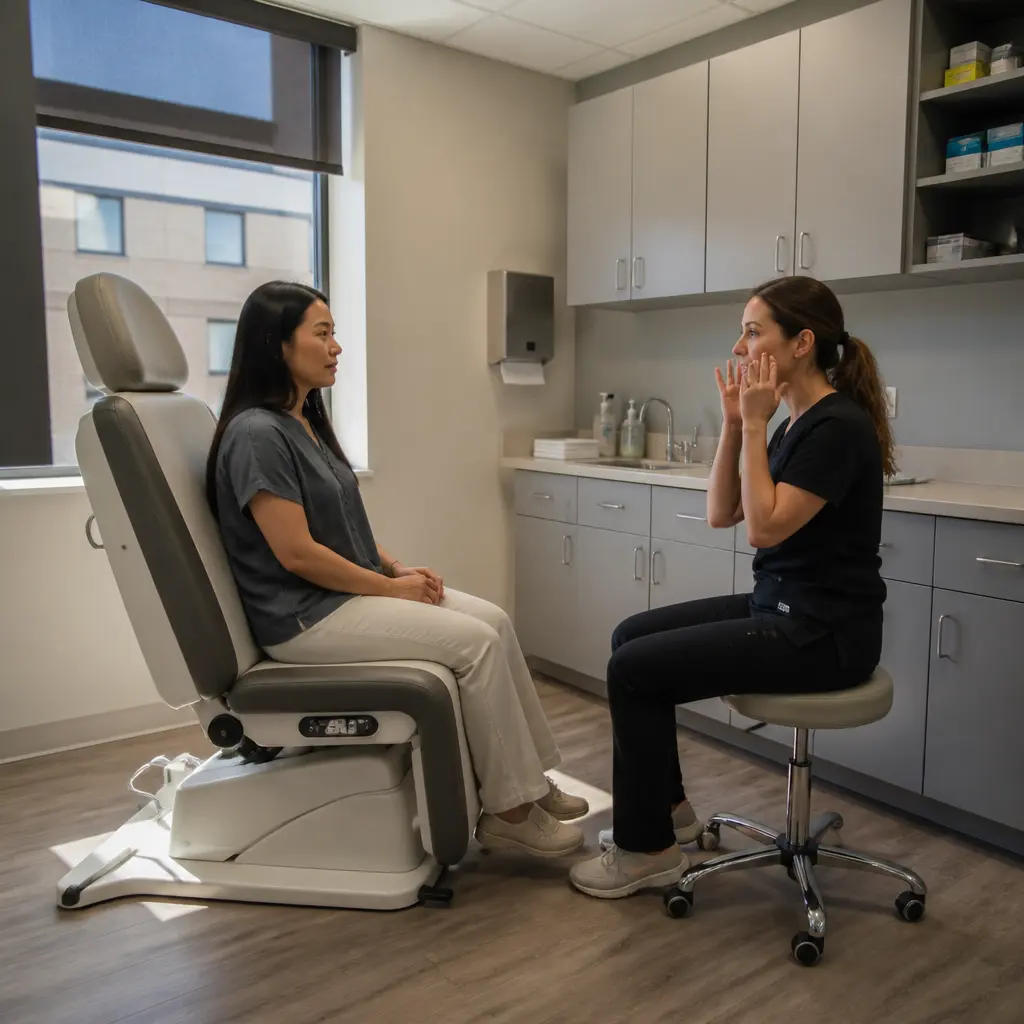
A fixed injection template may be convenient, but faces are not standardized. A patient with strong lateral brow depressors may need a different balance from someone with a naturally arched brow or asymmetrical muscle activity. The injector should examine the face at rest and during expression, ask about desired movement, and document pre-existing asymmetry before selecting injection sites.
Ignoring Pre-Existing Asymmetry
Most faces have some degree of natural asymmetry. Botox may reduce or reveal that difference rather than create it. If the patient and injector do not identify baseline asymmetry beforehand, a normal difference can be mistaken for a treatment complication. Photographs taken before treatment and during several expressions can help distinguish pre-existing features from changes that develop afterward.
Treating Areas That Require Extra Caution
The glabella, forehead, lateral eye area, lower face, and neck have different muscles and risk profiles. Lower-face injections may affect smiling, lip position, speech, or swallowing if toxin spreads to unintended muscles. The FDA prescribing information includes warnings about distant spread of toxin effect and advises attention to symptoms such as generalized weakness, difficulty swallowing, breathing problems, or vision changes. These symptoms require prompt medical evaluation.
Provider Skill and Consultation Quality
Provider skill includes knowledge of facial anatomy, appropriate product selection, sterile injection technique, dose calculation, complication recognition, and the ability to decline treatment when it is unsuitable. In the United States, Botox Cosmetic is a prescription medicine, and patients should verify that the procedure is performed by a qualified, licensed health professional who has substantial experience with facial injectables.
Choosing Price or Promotions Over Expertise
Very low prices can reflect differences in product source, injector training, supervision, follow-up, or the number of units used. Comparing only the advertised price may be misleading because providers may use different treatment plans and products. Patients should ask which product is being used, who will inject it, whether the product comes from an authorized source, and how complications and follow-up visits are handled.
Skipping the Full Facial Assessment
A rushed consultation often focuses on a single line rather than the movement pattern that produces it. A quality assessment considers skin quality, facial proportions, brow and eyelid position, muscle strength, medications, neuromuscular conditions, previous procedures, pregnancy or breastfeeding status, and the patient’s desired degree of movement. This broader evaluation supports a staged plan rather than an overly aggressive first session.
Patient Expectations and Aftercare
Patient expectations influence whether a result is judged natural. “Smooth” does not necessarily mean “expressionless,” and Botox cannot correct every cause of facial aging. A consultation should clarify which lines are dynamic, which are static, how much movement the patient wants to retain, and when the outcome should be assessed.
Expecting Immediate Perfection
Botox does not reach its final effect at the moment of injection. Temporary unevenness may change as different muscles respond at different rates. Patients should follow the injector’s instructions and attend a planned review rather than self-correcting or seeking additional toxin immediately. If a patient develops marked eyelid or brow drooping, significant facial weakness, trouble swallowing, breathing difficulty, or widespread symptoms, medical advice should be sought promptly.
Following Unsupported Aftercare Myths
Patients are often told to follow rigid rules that are not supported by strong evidence, such as avoiding all physical activity for extended periods or repeatedly exercising treated muscles. Aftercare instructions vary by clinician and treatment area, so patients should follow the provider’s specific guidance rather than relying on social-media claims. The most important practical step is communicating any unexpected symptom and avoiding additional cosmetic procedures until the result has been appropriately assessed.
How to Improve the Odds of Natural-Looking Botox
A conservative treatment strategy usually begins with the patient’s goals rather than the maximum possible wrinkle reduction. The following approach can help support a balanced result:
- Choose a qualified medical professional with relevant facial-injection experience.
- Discuss desired movement, prior treatments, medications, medical conditions, and baseline asymmetry.
- Ask for an assessment of the face at rest and during expressions.
- Start conservatively when the patient is new to treatment or uncertain about the desired degree of movement.
- Wait for the result to stabilize before considering a touch-up.
- Use sun protection and appropriate skin-care treatment for texture and static lines that Botox cannot address.
A useful way to visualize the decision process is a facial-treatment map showing baseline brow height, expression lines, muscle activity, and the proposed injection areas. Such a diagram can make asymmetry and treatment boundaries easier to discuss during consultation, although it cannot replace an in-person examination.
Conclusion: Botox and Natural-Looking Results
Natural-looking Botox is defined by selective muscle relaxation, preserved expression, balanced movement, and results that fit the patient’s anatomy. The most common mistakes are over-treatment, treating every line indiscriminately, using a standard pattern for every face, ignoring brow and eyelid mechanics, repeating injections too soon, and choosing an injector without adequate training or follow-up. Reviewing the FDA prescribing information, guidance from the American Academy of Dermatology and American Academy of Ophthalmology, and current procedural data from the American Society of Plastic Surgeons can help patients make informed decisions. Before treatment, patients should seek a qualified consultation, ask how natural movement will be preserved, and prioritize a staged plan over an aggressive promise of complete wrinkle removal.
Sources: U.S. Food and Drug Administration, Botox Cosmetic Prescribing Information, https://www.accessdata.fda.gov/drugsatfda_docs/label/2023/103000s5320lbl.pdf; American Academy of Dermatology Association, Botulinum Toxin; https://www.aad.org/public/cosmetic/wrinkles/botulinum-toxin; American Academy of Ophthalmology, Botox, https://www.aao.org/eye-health/drugs/botox; American Society of Plastic Surgeons, 2023 Plastic Surgery Statistics Report, https://www.plasticsurgery.org/documents/news/statistics/2023/plastic-surgery-statistics-report-2023.pdf; Carruthers J, Fagien S, Matarasso S, Consensus recommendations on the use of botulinum toxin type A in facial aesthetics, Plastic and Reconstructive Surgery, https://journals.lww.com/plasreconsurg/Abstract/2004/11001/Consensus_Recommendations_on_the_Use_of.1.aspx